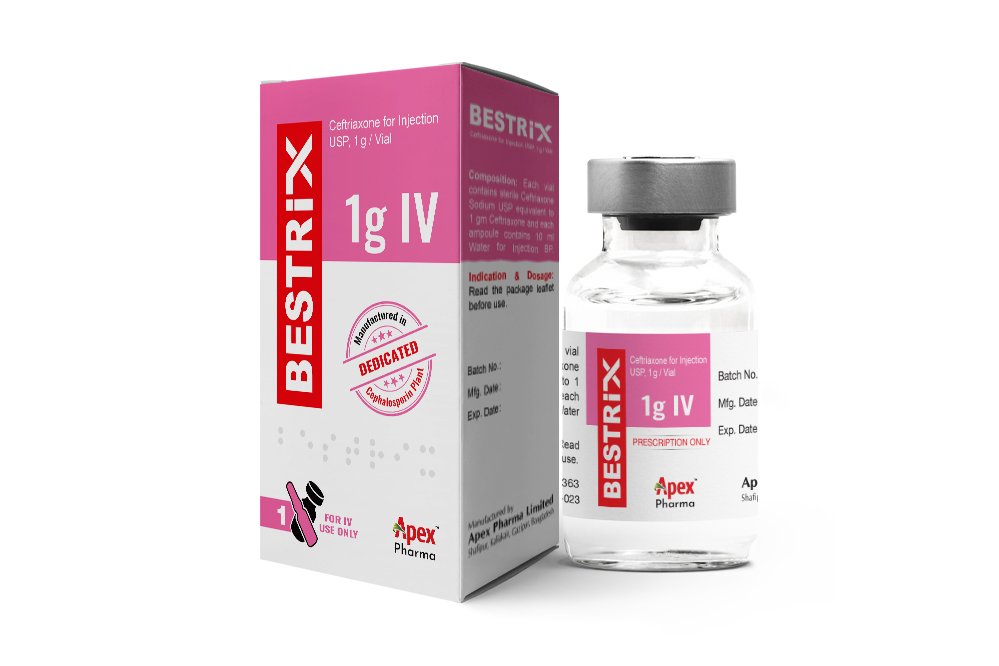
Bestrix (Export)
Home / By Brand Name / Bestrix (Export)
Composition
BESTRIX 500 mg IM injection: Each vial contains 500 mg Ceftriaxone (as sterile Ceftriaxone Sodium USP) accompanied by a solvent ampoule of 2 ml Lidocaine HCl BP 1% solution for IM injection.
BESTRIX 500 mg IV injection: Each vial contains 500 mg Ceftriaxone (as sterile Ceftriaxone Sodium USP) accompanied by a solvent ampoule of 5 ml Water for Injection BP for IV injection.
BESTRIX 1 g IM injection: Each vial contains 1 g Ceftriaxone (as sterile Ceftriaxone Sodium USP) accompanied by a solvent ampoule of 3.5 ml Lidocaine HCl BP 1% solution for IM injection.
BESTRIX 1 g IV injection: Each vial contains 1 g Ceftriaxone (as sterile Ceftriaxone Sodium USP) accompanied by a solvent ampoule of 10 ml Water for Injection BP for IV injection.
BESTRIX 2 g IV injection: Each vial contains 2 g Ceftriaxone (as sterile Ceftriaxone Sodium USP) and each of 2 ampoules contains 10 ml Water for Injection BP for IV injection.
Pharmacology
BESTRIX (Ceftriaxone) is a third-generation broad spectrum parenteral cephalosporin antibiotic. BESTRIX interferes with the synthesis of bacterial cell wall by inhibiting transpeptidase enzyme. As a result, the bacterial cell wall is weakened, the cell swells and then ruptures.
Indication
BESTRIX is indicated for the treatment of the following major infections when caused by susceptible organisms: Renal and urinary tract infections, lower respiratory tract infections, particularly pneumonia, gonococcal infections, skin and soft tissue, bone and joint infections, bacterial meningitis, serious bacterial infections e.g. septicemia, ENT infections, infections in cancer patients, prevention of postoperative infection, perioperative prophylaxis of infections associated with surgery and also in typhoid fever.
Dosage & Administration
BESTRIX (ceftriaxone) can be administered either intravenously or intramuscularly. When reconstituted for intramuscular or intravenous injection, the white to yellowish-orange crystalline powder gives a pale yellow to amber solution. Adults: The usual adult daily dose is 1-2 g once daily, (or twice daily in equally divided doses) depending on the type and severity of infection. The daily dose may be increased, but should not exceed 4 g. For preoperative use (surgical prophylaxis), a single dose of 1 gm administered intravenously 0.5-2 hours before surgery is recommended. In elderly patients, the dosages do not require modification provided that renal and hepatic functions are satisfactory. In patients with impaired renal function, there is no need to reduce the dosage of BESTRIX provided liver function is intact. In patients with liver damage, there is no need for the dosage to be reduced provided renal function is intact. Gonorrhea: For the treatment of gonorrhea (penicillinase producing and non-penicillinase producing strains), a single intramuscular dose of 250 mg is recommended. Children under 12 years: The recommended total daily dose is 50 to 75 mg/kg once daily (or twice daily in equally divided doses). In severe infections, up to 80 mg/kg body weight daily may be given. The total daily dose should not exceed 2 gm. In the treatment of meningitis, the initial dose of 100 mg/kg body weight (not to exceed 4 gm daily) once daily (or twice daily in equally divided doses), is recommended. As soon as the causative organism has been identified and its sensitivity, the doses can be reduced accordingly. The usual duration of therapy in meningitis is 7 to 14 days.
Contraindication
Ceftriaxone is contraindicated in patients with known hypersensitivity to the cephalosporin class of antibiotics.
Precaution
BESTRIX should not be given to patients with a history of hypersensitivity to cephalosporin antibiotics. It is contraindicated in premature infants during the first 6 weeks of life. Its safety in human pregnancy has not been established. Ceftriaxone is contraindicated in neonates if they require (or are expected to require) treatment with calcium-containing IV solutions, including continuous calcium-containing infusions such as parenteral nutrition because of the risk of precipitation of ceftriaxone-calcium.
Side Effect
BESTRIX is generally well tolerated. A few side-effects such as 1. Gastrointestinal effects include diarrhea, nausea and vomiting, stomatitis and glossitis 2. Cutaneous reactions include rash, pruritus, urticaria, edema & erythema multiforme 3. Hematological reactions include eosinophilia, thrombocytosis, leukopenia, and neutropenia 4. Hepatic reactions include elevations of SGOT or SGPT, bilirubinemia 5. CNS reactions include headache, hyperactivity, nervousness, sleep disturbances, confusion, hypertonia, and dizziness were reported. Local phlebitis occurs rarely following intravenous administration but can be minimized by slow injections over 2-4 minutes.
Use in Pregnancy & Lactation
BESTRIX has not been associated with adverse effects on fetal development in laboratory animals, but its safety in human pregnancy has not been established. Therefore, it should not be used in pregnancy unless absolutely indicated. Because ceftriaxone is distributed into milk, the drug should be used with caution in nursing women.
Drug Interaction
Potentially hazardous interactions: No impairment of renal function or increased nephrotoxicity has been observed in man after simultaneous administration of ceftriaxone with diuretics, or with aminoglycosides. A possible disulfiram-like reaction may occur with alcohol. Other significant interactions: BESTRIX doesn't interfere with the protein binding of bilirubin. Simultaneous administration of probenecid doesn't alter the elimination of ceftriaxone. Potentially useful interactions: Experimentally, in vivo, ceftriaxone has been shown to enhance bacterial killing by human neutrophils.
Overdose
In case of overdose, drug concentration would not be reduced by hemodialysis or peritoneal dialysis. There is no specific antidote. Treatment of overdose should be symptomatic.
Packaging
BESTRIX 500 mg IM injection: Each pack containing 1 vial 500 mg Ceftriaxone (as sterile Ceftriaxone Sodium USP) accompanied by 1 ampoule of 2 ml Lidocaine HCl BP 1% Solution for IV injection. It also contains complementary 1 set baby needle, disposable syringe (5 cc), alcohol pad and first aid bandage.
BESTRIX 500 mg IV injection: Each pack containing 1 vial 500 mg Ceftriaxone (as sterile Ceftriaxone Sodium USP) accompanied by 1 ampoule of 5 ml Water for injection BP for IV injection. It also contains complementary butterfly needle, disposable syringe (5 cc), alcohol pad and first aid bandage.
BESTRIX 1 g IM injection: Each pack containing 1 vial 1 g Ceftriaxone (as sterile Ceftriaxone Sodium USP) accompanied by 1 ampoule of 3.5 ml Lidocaine HCl BP 1% Injection for IM injection. It also contains complementary disposable syringe (5 cc), alcohol pad and first aid bandage.
BESTRIX 1 g IV injection: Each pack containing 1 vial 1 g Ceftriaxone (as sterile Ceftriaxone Sodium USP) accompanied by 1 ampoule of 10 ml Water for injection BP for IV injection. It also contains complementary of disposable syringe (10 cc), butterfly needle, alcohol pad and first aid bandage.
BESTRIX 2 g IV injection: Each pack containing 1 vial 2 g Ceftriaxone (as sterile Ceftriaxone Sodium USP) and each of 2 ampoules contains 10 ml Water for Injection BP for IV injection. It also contains complementary disposable syringe (20 cc), butterfly needle, alcohol pad and first aid bandage.
Storage ConditionsStore below 25°C, protected from light & moisture. Use reconstituted solutions immediately. Reconstituted solutions are stable for 6 hours at room temperature and for 24 hours at 2° - 8°C. It should not be mixed in the same syringe with any other drug than 1% lidocaine hydrochloride injection BP (for IM injection only).
PRODUCTS
Apex Pharma Has
60+ Pharmaceuticals Brands
of Different Generics